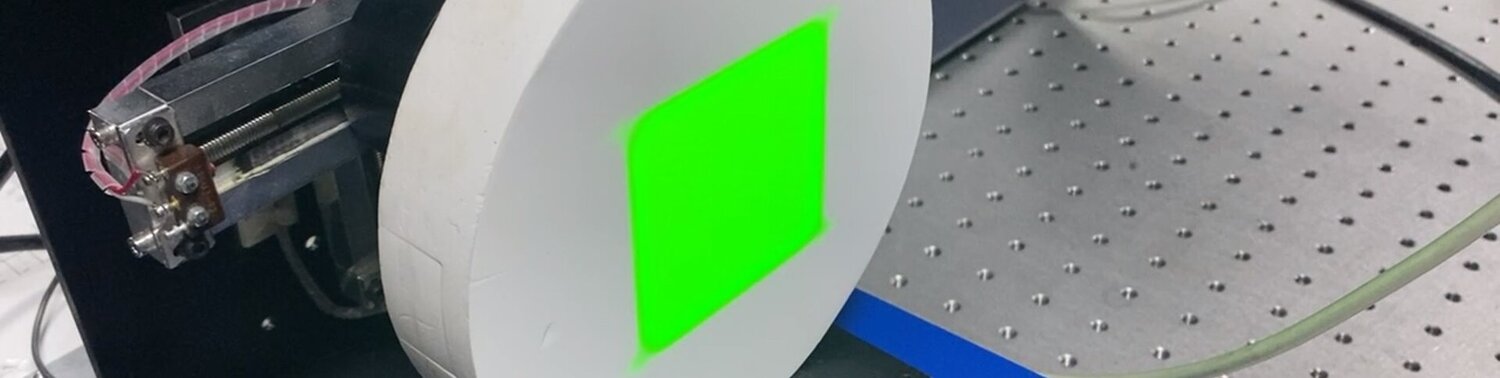
FCH Fibre-Coupled Optical Homogeniser
Optical Design
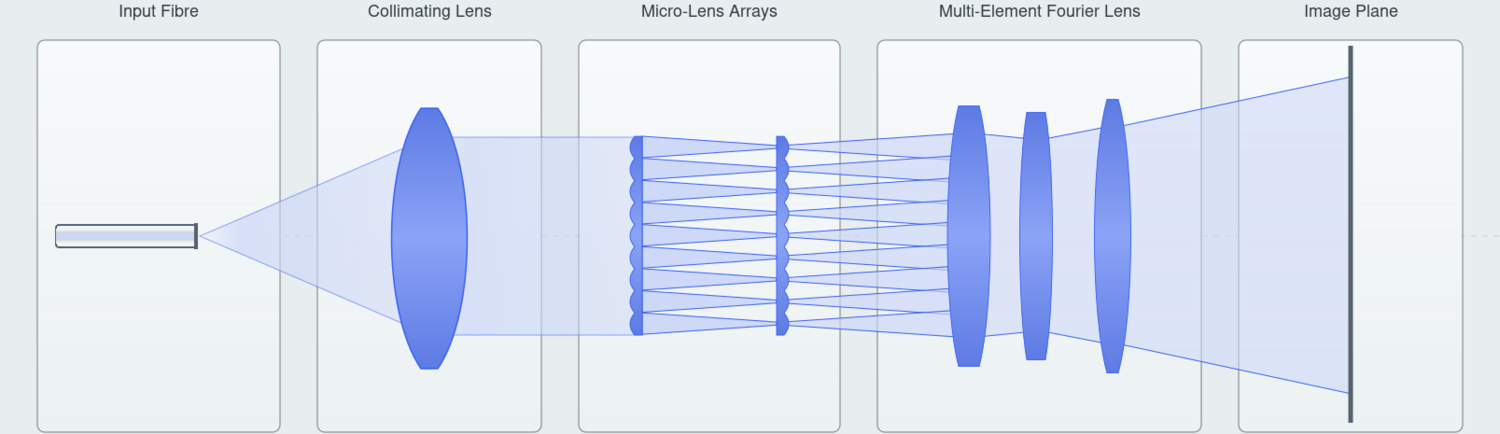
The FCH uses a fibre-fed microlens-array optical architecture to convert light from a multimode fibre into a large, square, spatially uniform illumination field.
The optical path, shown schematically in Figure 1, consists of a fibre input, collimating lens, bespoke MLA pair, and custom three-element Fourier lens. The microlens arrays are designed and manufactured specifically for the homogeniser geometry, balancing throughput, field size, and uniformity.
The Fourier lens images the homogenised field onto the working plane. Its bespoke three-element design improves field quality at the corners of the square output and helps control chromatic aberration across the broad 200 nm to 2.5 µm spectral range.
Beam Geometry
The FCH is available in two standard projection geometries, providing either a 60 mm × 60 mm field at 493 mm working distance or a 120 mm × 120 mm field at 1080 mm working distance.
Figures 2 and 3 show the external geometry of each configuration to scale, including the homogeniser body, projected beam envelope, and working plane. These diagrams illustrate the space required around the instrument and the beam expansion between the output aperture and the illuminated field.

and 60 mm × 60 mm field at 493 mm working distance.

and 120 mm × 120 mm field at 1080 mm working distance.
For quantitative details including numerical apertures see the specifications page.
Uniform Square Illumination
The Bentham Fibre-Coupled Homogeniser converts fibre-delivered light into a large, square, flat-top illumination field at the working plane. Its MLA-based optical design is optimised for applications where both irradiance and spatial uniformity are important.
- Square projected field for simple alignment to sensors, samples, cells, and camera fields
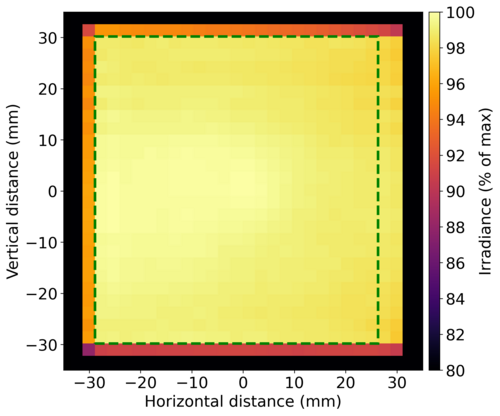
- U2 ≥ 98% spatial uniformity across the projected field
- Large contiguous regions achieving U2 ≥ 99%
- Broadband operation from 200 nm to 2.5 µm
Fibre Compatibility
The FCH is designed for use with standard multimode fibre delivery. It is compatible with 0.22NA fibre and is typically used with fibre cores from 200 µm to 800 µm.
SMA-905 and FC-PC fibre interfaces are available as standard options, with other connector formats available for specific sources or system requirements.
- Compatible with 0.22NA multimode fibre
- Recommended fibre core: 200 µm to 800 µm
- Standard interfaces: SMA-905 and FC-PC
- Suitable for fibre-coupled broadband, monochromatic, LED, LDLS, laser, and supercontinuum sources
Spatial Uniformity
The projected field is designed to be useful across a practical measurement area, not only within a small central region. As shown in Figure 4, the Bentham Fibre-Coupled Homogeniser provides a clean, repeatable illumination patch that reduces sensitivity to sample placement, detector position, and local illumination structure.
| Uniformity Area | FCH-500 | FCH-1000 |
|---|---|---|
| Typical, U2 > 98% | 3300 mm² | 13200 mm² |
| Typical, U2 > 99% | 1200 mm² | 4800 mm² |
| Max, U2 > 99% | 1800 mm² | 7200 mm² |
Uniformity area is the largest contiguous measured area meeting the stated U2 criterion. U2 is the minimum grid-cell irradiance divided by the maximum grid-cell irradiance within that area.
Source Pairing
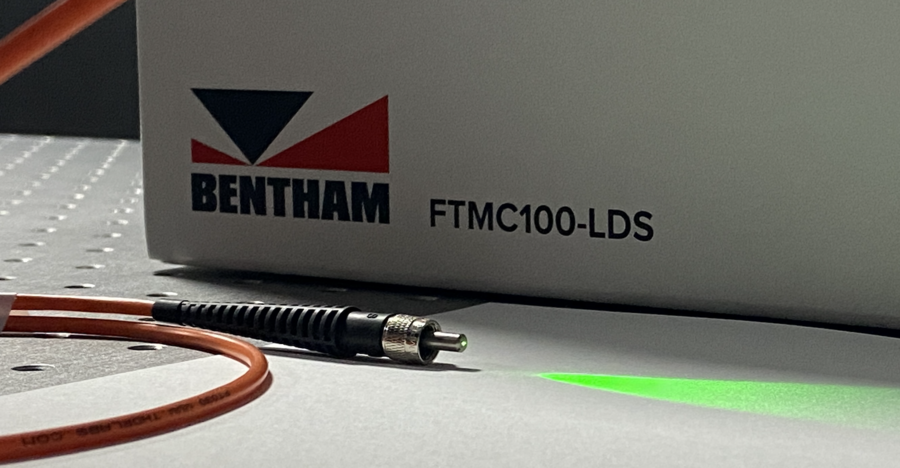
The Bentham Fibre-Coupled Homogeniser accepts standard fibre-coupled optical sources and is especially well matched to Bentham fibre-coupled tuneable light-source systems. It can be used as the final illumination stage in systems based on LDLS sources, supercontinuum lasers, fibre-coupled LEDs, laser sources, and other broadband or monochromatic fibre outputs.
| System | Typical Use |
|---|---|
| FTMC100-LDS | High-power wavelength-tuneable illumination from LDLS sources |
| FTMC50-SCL | High-intensity monochromatic output from supercontinuum lasers |
| FTMC50V | High-efficiency fibre-to-fibre monochromator for existing fibre-coupled sources |
| TLS120Xe | Compact Xenon Tuneable Light Source |
| Direct fibre source | LED, laser, LDLS, or other fibre-coupled outputs |
Customisation
Standard configurations cover the most common requirements, while custom configurations can be supplied for specific instruments, sources, and measurement geometries.
Options include:
- projected field size or geometry
- working distance
- fibre connector
- input count and source-selection arrangement
- source combination
- mounting and integration features
- spectral-range optimisation