
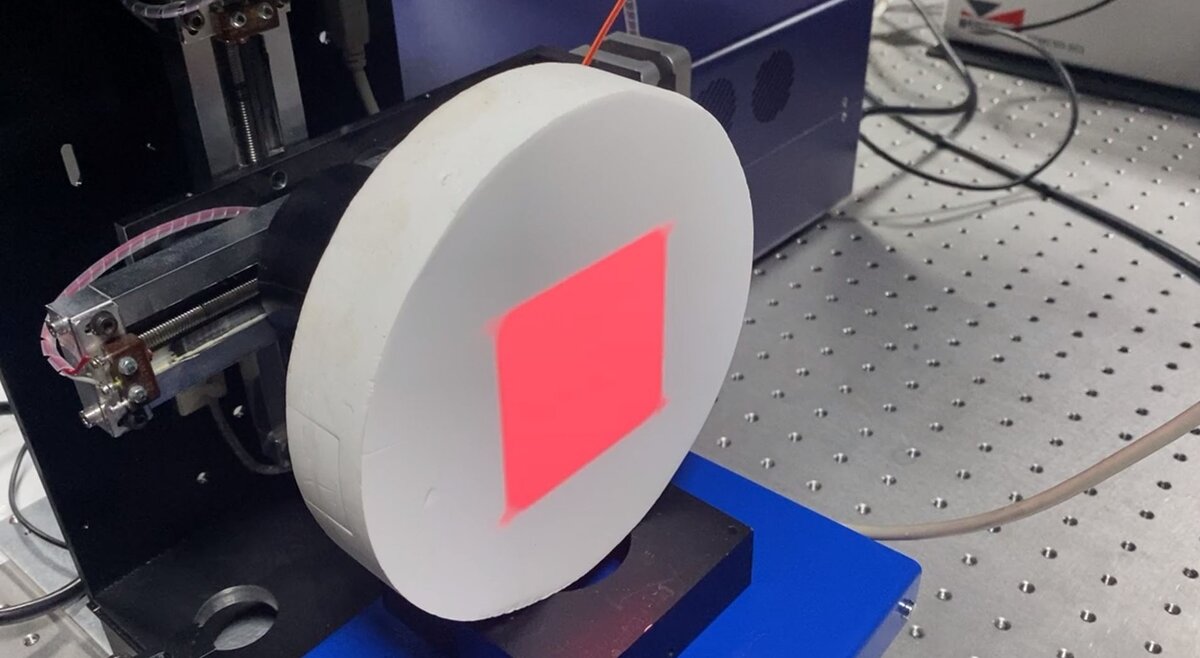
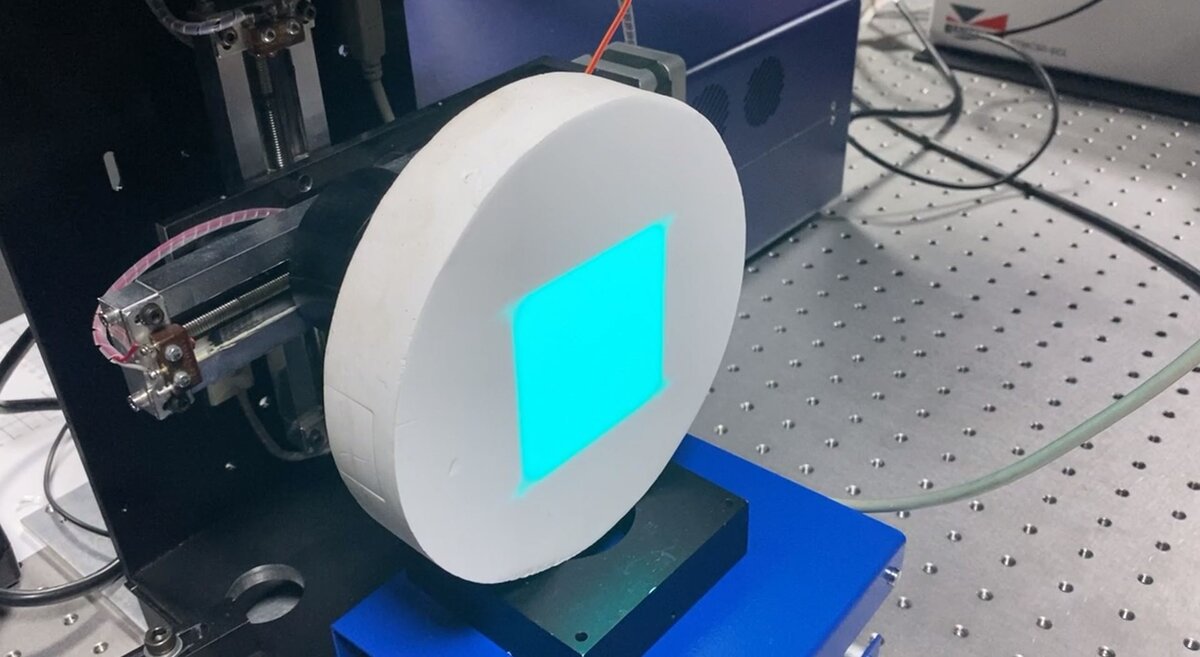
200 nm to 2.5 µm fibre-coupled square flat-top illumination with U2 ≥ 98%
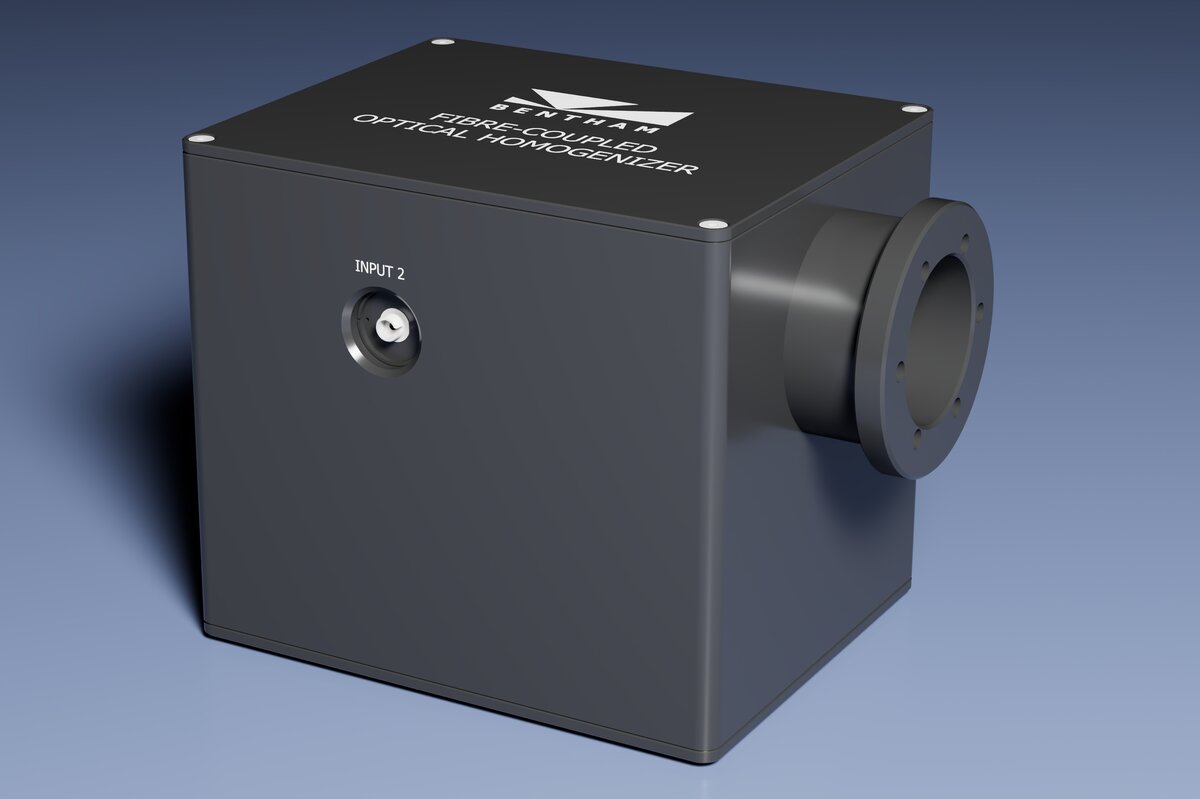
The Fibre-Coupled Optical Homogeniser (FCH) is a microlens-array (MLA) based optical homogeniser that converts fibre-delivered light into a large, square, spatially uniform illumination field at the sample plane.
Available with 60 mm × 60 mm and 120 mm × 120 mm projected fields, it is designed for applications requiring both high irradiance and high spatial uniformity. When paired with Bentham fibre-coupled monochromator and broadband-source systems, it provides highly uniform, wavelength-tuneable illumination across a broad 200 nm to 2.5 µm spectral range.
Applications
The FCH is well suited to applications that require broadband or monochromatic light to be delivered evenly over a defined area, with high irradiance and a very high degree of spatial uniformity.
Typical applications include:
- Detector characterisation: uniform illumination supports responsivity, linearity, saturation, spatial-uniformity, and spectral-response measurements.
- Camera and image-sensor testing: a flat, repeatable field supports pixel-response uniformity measurements, flat-field correction, vignetting analysis, and colour or spectral-sensitivity testing.
- Solar-cell QE/EQE measurement: the homogenised output provides consistent irradiance across the cell or sub-cell area, improving the reliability of wavelength-dependent quantum-efficiency measurements.
- Hyperspectral and multispectral imager calibration: a uniform source field enables radiometric calibration, spatial-response correction, and channel-to-channel comparison across the instrument field of view.
- Sample-plane illumination: suitable wherever a test sample, sensor, optical system, or calibration target must be illuminated evenly over a defined area.
Uniform Illumination Over a Practical Working Area
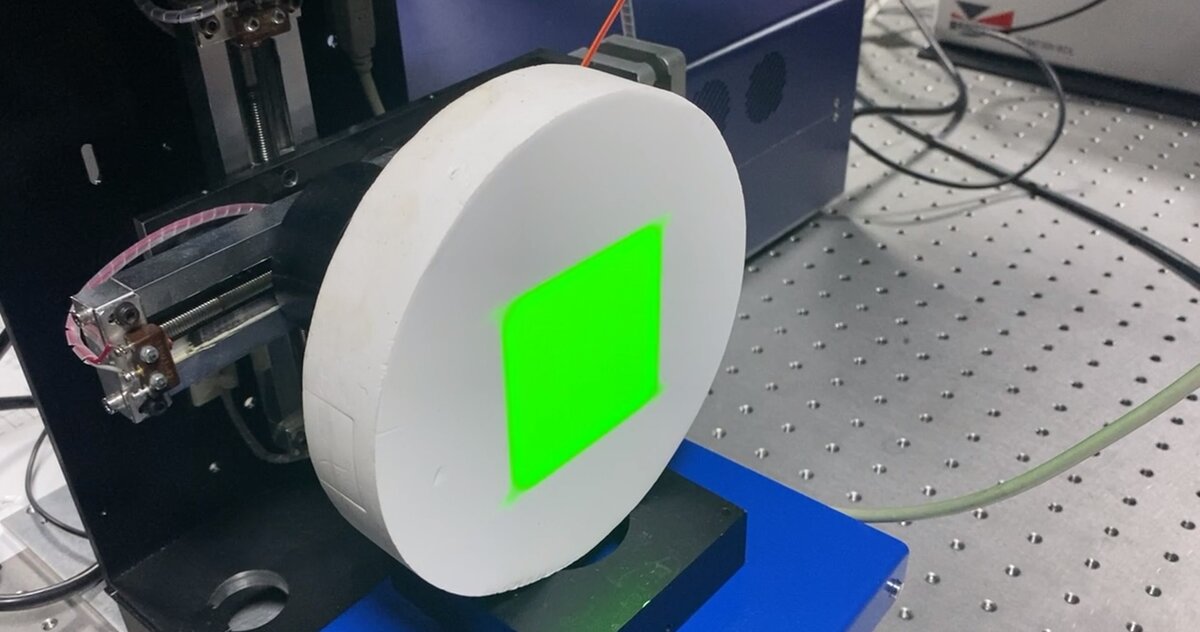
The FCH converts fibre-delivered light into a large, square, flat-top illumination field, providing a practical measurement plane for calibration, characterisation, and test applications.
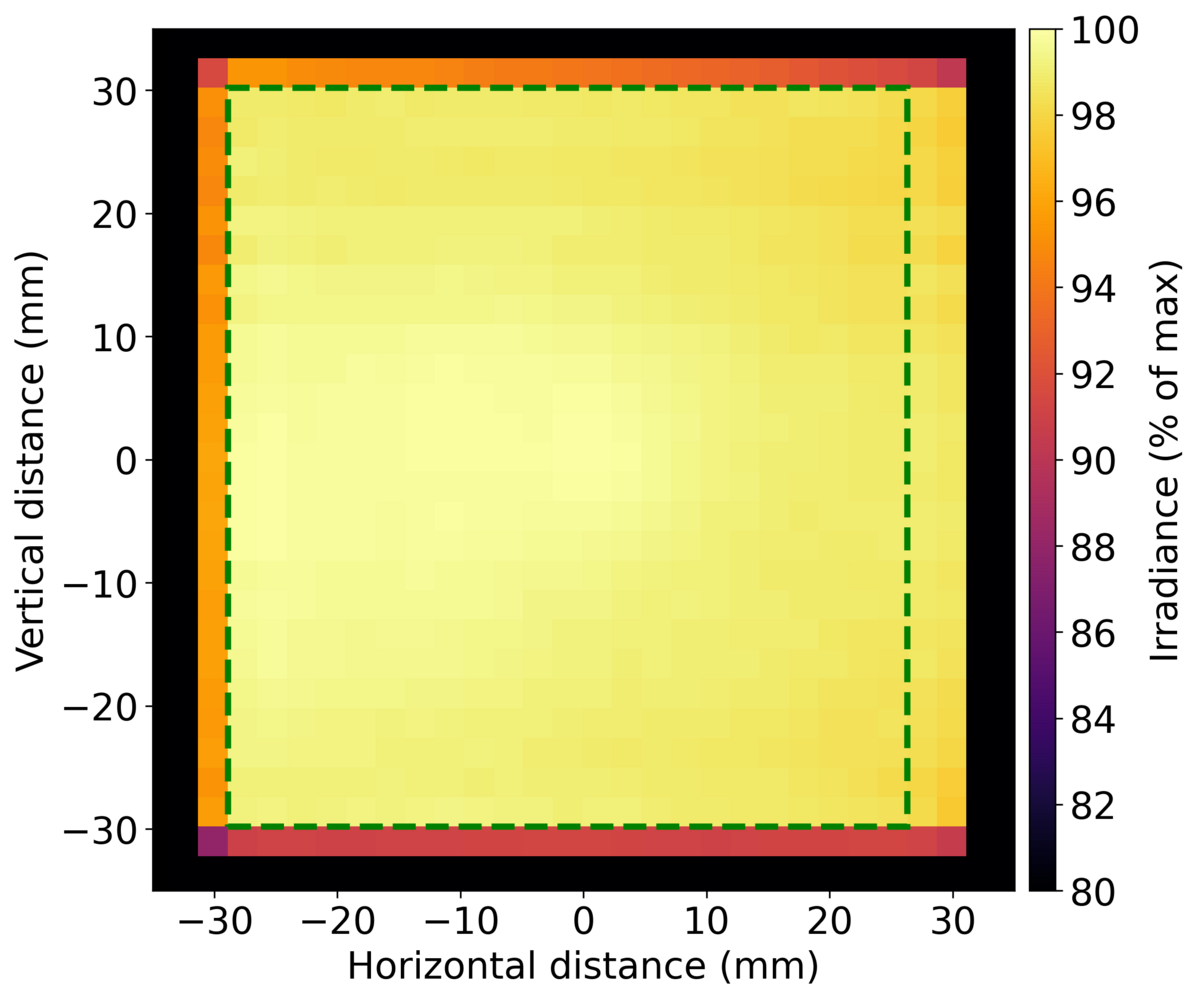
- U2 ≥ 98% spatial uniformity across the projected field
- Large contiguous regions achieving U2 ≥ 99% uniformity
- Square flat-top output for simple alignment to sensors, cells, samples, and camera fields
- Reduced sensitivity to sample placement and local illumination structure
- Broadband homogenised illumination from 200 nm to 2.5 µm
Detailed uniformity maps and numerical performance data are provided in the optical specifications.
Compact, Stable, and Easy to Integrate
The FCH Homogeniser delivers highly uniform illumination from a compact optical assembly. With an envelope below 250 mm × 154 mm × 170 mm, it is well suited to integration into laboratory instruments, test stations, and optical benches where space is limited.
Its mechanically stable optical design provides U2 ≥ 98% spatial uniformity with high repeatability, supporting reliable alignment retention and long-term measurement confidence.
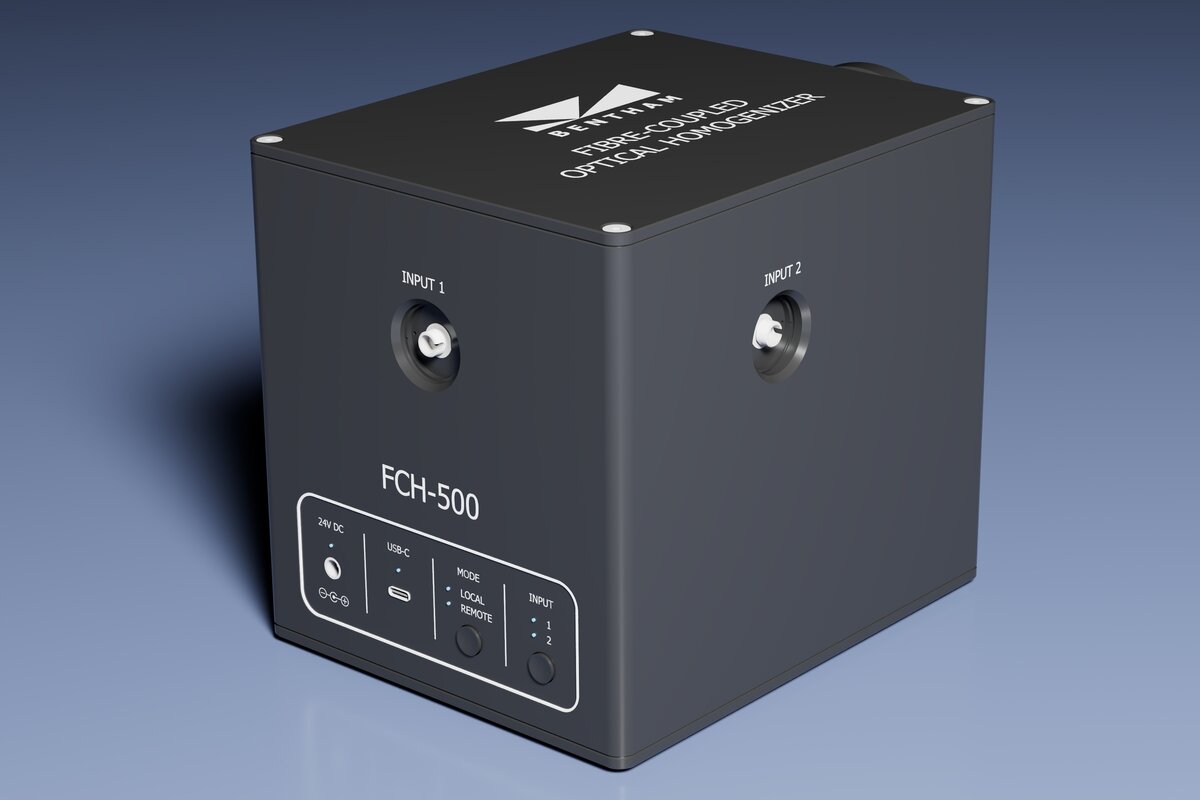
Single-input and two-input configurations are available. The single-input model provides a passive optical path for fixed-source installations. The two-input model adds motorised source selection, allowing users to switch reproducibly between two fibre-coupled sources from the front panel or via USB, without disturbing the optical setup.
Both configurations are designed to provide stable, repeatable homogenised illumination for calibration, characterisation, and test applications.
Configuration Options
The FCH is available in four standard configurations, with a choice of projected field size and input arrangement.
- FCH-500: 60 mm × 60 mm square field at 500 mm working distance
- FCH-1000: 120 mm × 120 mm square field at 1000 mm working distance
- Single-input version for a simple, entirely passive optical path
- Motorised dual-input version for selectable fibre-coupled sources, with front-panel buttons, status LEDs with dark mode, and USB control
Single-input models provide maximum simplicity: no power, no controls, and no moving parts. Dual-input models add convenient, reproducible source selection for systems using multiple light sources or spectral ranges.
A range of fibre interfaces can be accommodated, including SMA-905, FC-PC, and other connector formats to suit the source and application.
